




.png?Status=Temp&sfvrsn=91c53d6b_2 "INTRUST")
A fiduciary perspective on staying invested through uncertainty


Read time: 10 minutes
- Headlines are constant. Compounding is long.
- Process matters more than predictions.
- Diversification reduces single headline risk.
- Rebalancing keeps risk aligned to the plan.
- Timing mistakes create an investor return gap.
Headlines change. Discipline should not.
Every generation experiences a different set of market headlines. One decade it’s inflation and oil. Another decade it’s recession risk, a financial crisis, or a sudden geopolitical shock. The details change, but the investor challenge stays the same: deciding whether to react in the moment or stay anchored to a long-term plan.
INTRUST Bank has served communities around the region since 1876 and has served as an investment fiduciary for more than 100 years, which means we’ve seen our clients through local, national, and international events that run the gamut. And importantly, as an investment fiduciary, we’re legally and ethically obligated to put our clients’ interests first when making decisions about money.
Although our long history as a fiduciary doesn’t provide a crystal ball, it allows us to anticipate uncertain times and make well-informed, time-tested market recommendations. That’s what ‘discipline’ means. It’s a commitment to steady decision-making regardless of headlines, remaining focused on strategies that continuously support what you’ve told us matters to you.
How do we do this? By embracing a full-service mindset, diversification strategies, and disciplined risk management as practical approaches in a world defined by uncertainty. In this article, we’ll explore what that means through five lessons that summarize our fiduciary way of thinking.
Lesson 1: The news cycle is short. Compounding is long.
|
We’ve navigated many periods that felt uniquely difficult in real time and have learned that discipline and a long horizon matter more than headline-by-headline reactions. |

A helpful way to reset perspective is to look at a long market chart with major events marked. There’s a pattern. Markets fall, markets recover, and the long-term trend is built by investors who stayed aligned to a plan. Drawdowns are not pleasant, but they are part of investing.
The 2008 Global Financial Crisis tested confidence in the system itself, and liquidity suddenly mattered as much as valuations. Later came European debt scares, the pandemic shock in 2020, and the inflation-driven regime shift of 2022.
The visual below is not meant to minimize risk but rather put it in context. Even when markets respond quickly to scary news, rebounds occur due to innovation, productivity, and the simple fact that businesses adapt.
Seeing that pattern helps investors remain calm but calm alone is not a strategy — it must lead to turning headlines into measurable signals and disciplined decisions.
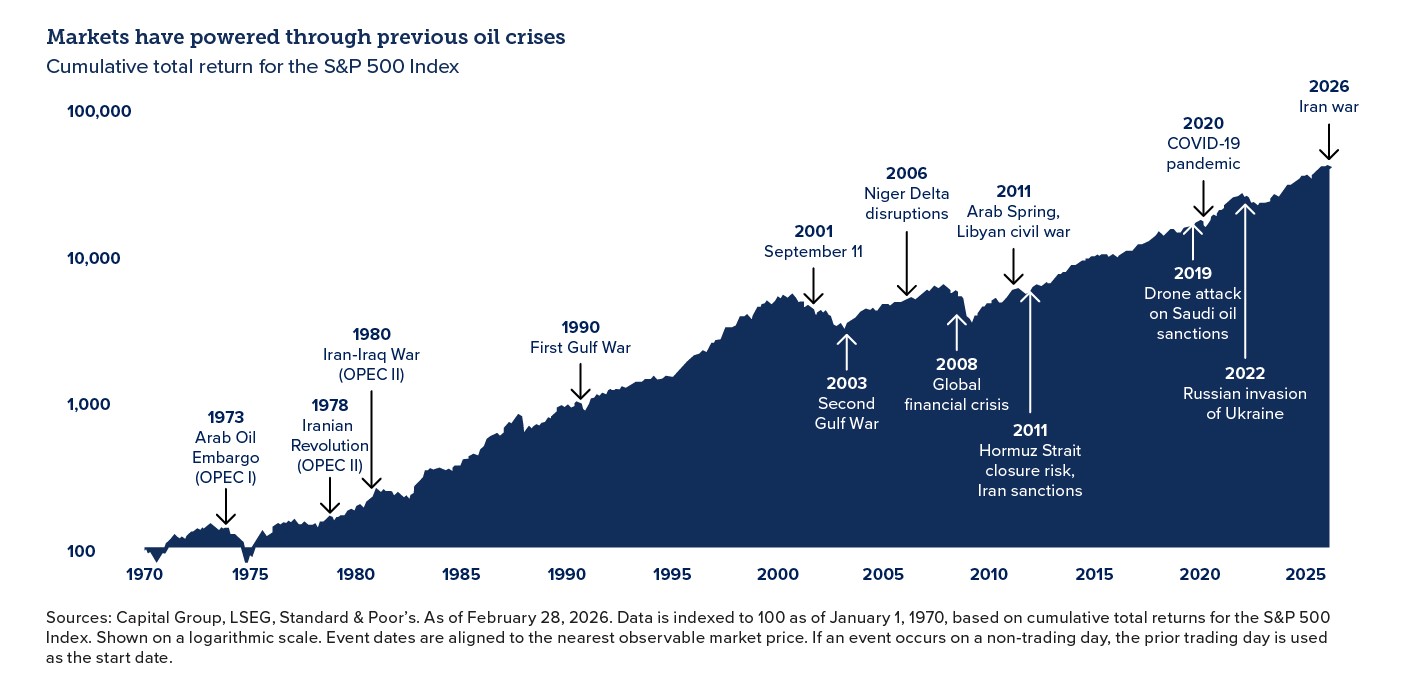
Market reactions during previous global oil crises.
Lesson 2: Process beats prediction, especially in geopolitics.
Many geopolitical events produce empty, short-term volatility in the market, but the real market impact occurs when they materially change drivers of the economy; factors such as energy costs, inflation, interest rates, currency moves, or credit conditions. Those are measurable signals. Measurable signals are objective, trackable data that help us separate “loud news” from “meaningful change.” These signals can drive disciplined decisions.
|
When something breaks in the world, the natural question is, “What happens next?” |
Some investment management firms build portfolios as a series of trades dependent on discrete outcomes for a company or the economy, but we enhance that strategy by acknowledging the uncertain world we live in and evaluating investment outcomes over a range of scenarios.
This doesn’t mean that we ignore the reality of the moment, but often, movements in the real world are within our range of expectations as we construct investment allocations.
The INTRUST process is designed to establish clear portfolio guidelines before volatile markets test our resolve.
- We confirm goals, time horizon, risk tolerance, and liquidity needs thoughtfully.
- We diversify by design.
- We rebalance with rules informed by your financial plan.
- We communicate with our clients to keep them informed of our thinking and advice.
- We adjust allocations only based on measurable signals, not the headline of the day.
- We regularly consider how adjustments might affect the other pillars of your generational wealth strategy including tax and estate planning.
Once the outcome of this process is clear, we build your portfolio to align with it. That’s where diversification becomes less of a slogan and more of the plan’s shock absorber.
Lesson 3: Diversification is a shock absorber, not a slogan.
|
Different assets respond differently to different problems. Diversification reduces the odds that a single surprise derails the whole plan. |
Diversification is often described with the phrase, “Don’t put all your eggs in one basket.” Although true, there’s more to it than that. The deeper point is that assets handle stress differently. Diversification supports resilience, so one shock doesn’t undo the larger strategy.
This is also why the asset class “winner” changes so often. A diversified investor doesn’t need every piece of the portfolio to win every year. The goal is for the overall plan to remain resilient across environments.
Diversification sets the foundation, but portfolios don’t stay balanced on their own. Over time, market moves cause drift, which is why disciplined rebalancing matters.
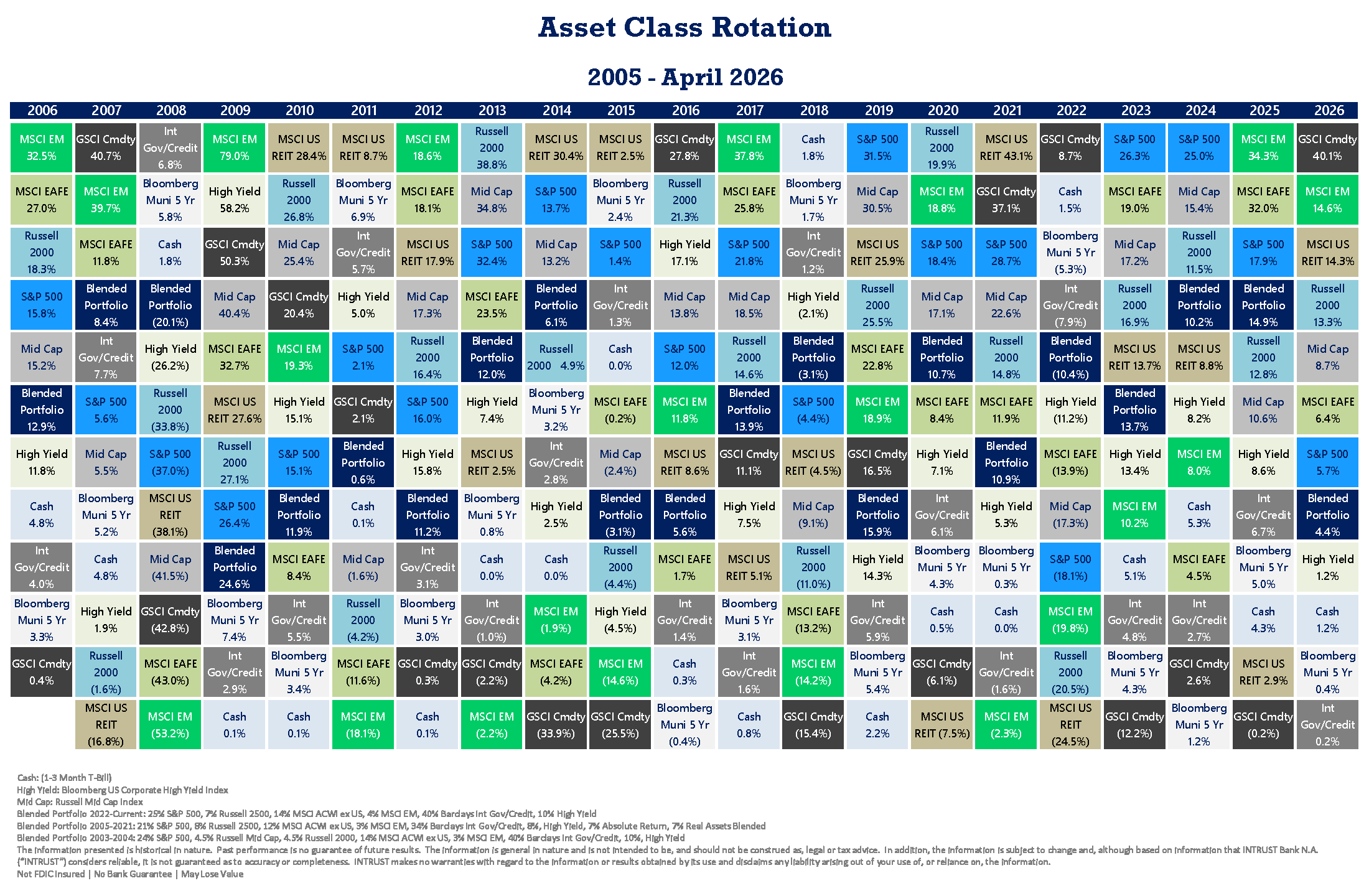
This chart shows how different asset classes perform from year to year, with leadership rotating frequently over time. The wide variation highlights why diversification matters. No single asset class stays on top, and spreading investments helps manage risk over market cycles.
Lesson 4: Portfolio maintenance helps prevent risk drift.
Investors often hear, “Let your winners run,” which is the idea that strong performers shouldn’t be sold too soon. When stocks have a strong run, they naturally become a larger part of the portfolio, pushing risk higher. Conversely, when they fall, the portfolio can tip in the other direction, becoming more conservative than planned.
Portfolio maintenance, or rebalancing, is the simple act of bringing the portfolio back toward its target mix, ensuring market movement doesn’t change the strategy itself. The purpose of rebalancing is not to outsmart the market. It’s to keep risk honest, and to replace emotional decisions with rules.
|
Portfolio maintenance, or rebalancing, is a risk and behavior discipline rather than a performance trick. |
Research published in the Journal of Financial Planning1 suggests that how you rebalance matters more than how often you trade. In its analysis, opportunistic rebalancing — or monitoring frequently and trading only when needed — more than doubled the average benefit compared with traditional annual rebalancing. This means most of the value of rebalancing comes from having a rule and applying it when it matters rather than trading based on a calendar.
In a separate study, the Journal of Financial Management2 also found that rebalanced equity strategies outperformed buy‑and‑hold approaches by more than 100 basis points annualized over a five‑year period. In essence, when you rebalance volatile, imperfectly correlated assets, the math has historically created a diversification bonus over time. It isn’t guaranteed, but the potential benefits are meaningful enough to warrant attention.
Rebalancing helps manage the portfolio’s risk inside the account. The next challenge is outside the account: investors’ natural urge to change course at exactly the wrong time.
Lesson 5: Behavior shapes returns as much as markets do.
When most people look up performance, they see total returns. Those returns assume an investor bought, held, and stayed invested for the full period. Real life is messier. Investors add money at different times, withdraw money at different times, and sometimes change course at the worst possible moment. Investors often feel a natural urge to “time” the market, but it’s often costly.
|
Pairing a sound portfolio with consistent behavior across many cycles gives compounding the time it needs to work. |
Morningstar’s “Mind the Gap” research3 compares a fund’s reported total return with the dollar-weighted return investors actually experienced. In the 2025 report, Morningstar found that over the 10 years ending December 31, 2024, the average investor return lagged the average fund total return by about 1.2 percentage points per year.
DALBAR’s investor behavior work4 highlights a similar pattern in strong market years. Investors can miss a meaningful share of market gains when they move in and out of the market at the wrong times.
Two people can own the same investment and have two different experiences. One contributes steadily and stays invested. Another adds money after strong markets and pulls back after scary ones. The fund’s total return may be identical for both, but the investor’s return is shaped by behavior and timing. The point is not perfection but rather to build a plan that makes it easier to stay consistent.
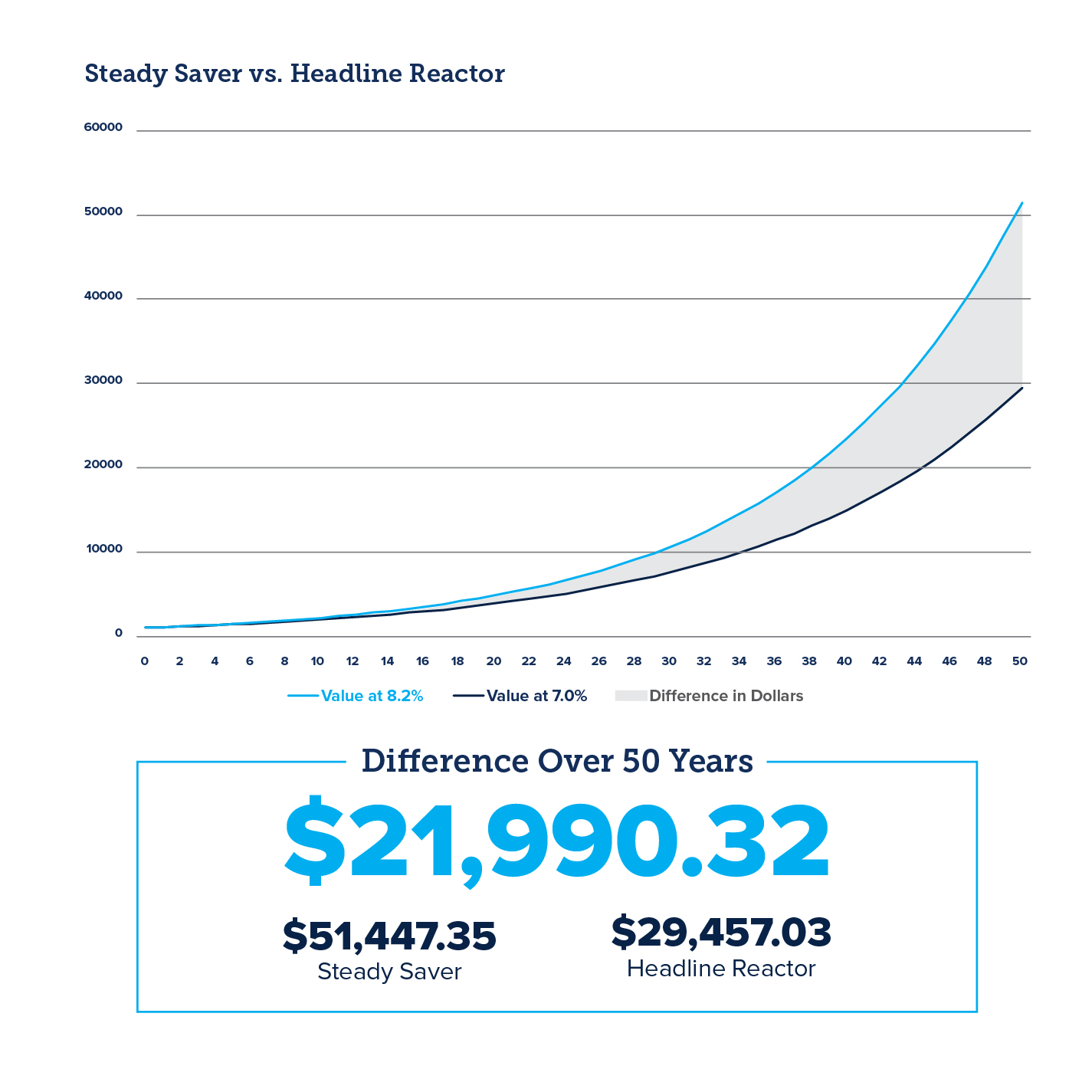
This chart demonstrates the power of compounding over a long period of time. Morningstar research3 finds that the average investor realized investment returns 1.2 percentage points below the reported returns of the funds (7.0% vs 8.2%) largely due to mistimed decisions like jumping in and out of the market. 1.2% may not sound like much, but when compounded over long periods of time, this difference becomes substantial.
When applied consistently, durable principles and discipline can make a lasting difference.
A long investing history teaches humility. Markets will always find new ways to surprise us, and headlines will never stop changing. The most reliable response is rarely dramatic. It’s the steady application of durable principles: diversify thoughtfully, rebalance with discipline, and stay focused on long-term goals.
A well-constructed plan allows for steady progress without losing sight of what matters. We’ll use our more than 100 years of experience to help you build that, prioritizing the patience and discipline it takes to create generational wealth regardless of the inevitable uncertainties.
Investment management is only one piece of INTRUST’s broader approach to generational wealth. Our team works across five pillars, Financial Planning, Investment Management, Tax Planning, Estate Planning, and Charitable Planning, because investment discipline is most effective when it is integrated with the rest of a client’s financial life. That integration includes goal and cash-flow planning, risk evaluation and stress testing, tax-smart portfolio implementation, annual document and gifting reviews, and charitable giving strategies. In other words, the same steady, rules-based mindset that helps investors navigate markets is mirrored across the full set of services that support a long-term plan and an enduring legacy.
For more on INTRUST Wealth, meet our team or send us a message.
FAQ
1 Financial Planning Association - Opportunistic Rebalancing: A New Paradigm for Wealth Managers
2 The Journal of Portfolio Management - Measuring Portfolio Rebalancing Benefits in Equity Markets
3 Wealth Management - Morningstar: Investors Miss Out on 15% of Fund Total Returns
4 DALBAR - Investors Missed the Best of 2024’s Market Gains, Latest DALBAR Investor Behavior Report Finds
This material is provided for informational purposes only and is not a recommendation to buy or sell securities. Past performance is no guarantee of future results. Market and economic conditions are subject to change. For additional information and to discuss your specific situation, please contact your INTRUST Advisor.
| Not FDIC Insured | No Bank Guarantee | May Lose Value |
Posted:
06/02/2026
Category:
Related Blog Posts
